You control the hosting accounts, billing, administrator access, and backups. You pay no software license fees for the included open-source components. I train one person to handle routine maintenance with AI and runbooks.
I size the setup around your users, storage growth, uptime needs, and recovery goals. The brief lists the specific equipment or provider resources to order and who will administer them.
Existing equipment
I check available CPU, memory, storage health, network capacity, and whether the hardware has a workable replacement path.
New bare metal
I specify the hardware, disks, power protection, network ports, and off-site backup capacity. You place the order.
VPS or cloud
I specify the region, instance sizes, storage, networking, and backup destination. You open the account and pay the provider.
Sample purchase brief for a 12-person office
For a files-and-CRM workload that can tolerate a single-server outage, start the assessment with one 8-core host, 32 GB RAM, two 2 TB SSDs in a mirror, a UPS with shutdown signaling, and a separate encrypted off-site backup destination. I confirm capacity from your current data and growth before you order.
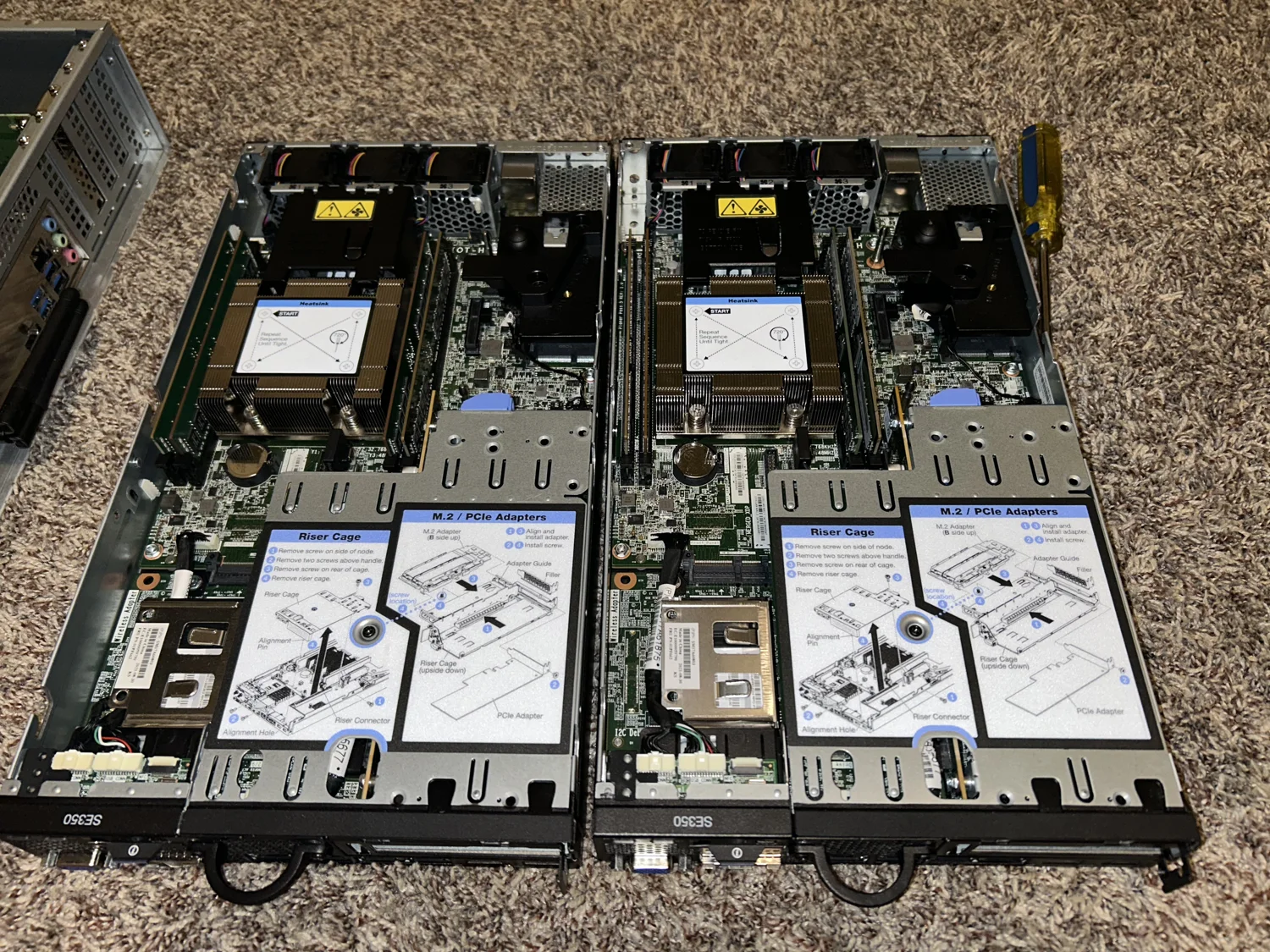
The two Lenovo ThinkSystem SE350 nodes in my Antalos lab
One example pairs Nextcloud Community for files with Keycloak for identity and restic for backups. I check the supported sign-in connector on the versions we plan to deploy and test file recovery before handoff.
I itemize application modules and migration in the project quote. You pay infrastructure providers from your own accounts. Before I set the price, I assess application compatibility and the requirements for database availability, shared storage, and ingress.
Choose where it runs
Use your own hardware, rent a VPS, or choose a managed Kubernetes platform for a suitable HA design. The provider owns rented hardware. Your team retains control of the account, data, configurations and workloads. Actual costs depend on a workload assessment.
Customer-owned hardware
$20–$150 / month
Illustrative power and connectivity allowance. Budget separately for equipment, backups and labor.
Cloud VPS
$30–$300 / month
Illustrative compute allowance. Add storage, backups and networking for your workload.
Managed Kubernetes
$150–$800 / month
Illustrative cluster allowance. Region, control plane, nodes, ingress and storage affect the total.
Architecture and operations
Users and administrators
↓
TLS ingress, VPN and identity · Routing, private access and sign-in
↓
Business applications · Compose services or Kubernetes workloads
↓
Databases and storage
Metrics, logs and alerts
Offsite backups
Users reach applications through TLS ingress and identity controls. The deployment connects the applications to persistent data, observability and backups. Administrators submit approved changes through a version-controlled deployment repository.
Version-controlled changes
I use infrastructure as code to provision environments from the same configuration. With GitOps or a comparable review process, administrators can see changes and roll them back.
Identity and networking
I configure centralized authentication for applications that support it. We agree on who can reach each service and how to apply TLS, network segmentation, and access policies.
Monitoring and recovery
I set up metrics and alerts for key services. I configure offsite backups, document the restore procedure, and test it against the retention and recovery goals.
Documentation and administrator training
I hand over the architecture diagrams and deployment repositories. Your administrators receive operating and troubleshooting runbooks, instructions for backups, restores, and upgrades, and hands-on training.
Monitoring detects a potential issue.
AI reads permitted metrics, logs and runbooks.
AI proposes a diagnosis or change.
An administrator reviews and approves the action.
The deployment workflow applies the approved change.
The operator checks and records the outcome.
AI-searchable documentation and diagnostics can use a self-hosted model where practical. Production actions require least-privilege access, human approval and an auditable change record.
Expanded AI operations assistant
$1,500–$4,000
One-time professional services · USD
Expanded setup for additional diagnostic and documentation sources. Your business controls the model environment and pays any provider charges.
Additional training and handoff
$750–$2,000
One-time professional services · USD
Deployment includes administrator training and an AI-assisted runbook for the agreed stack. Choose this option for longer workshops or standalone training.
Review the applications and prepare a project brief. We’ll agree on the scope and tests before I deploy the system and hand it over.
Frequently asked questions
What do I own in the cloud?
You control your cloud account, data, configuration, and workloads. The cloud provider owns the physical equipment that runs your rented services.
Does Kubernetes make an application highly available?
Availability depends on the application’s replication behavior, network and ingress, database failover, shared storage and failure domains. I assess and test each component as part of the availability design.
Can I run the system without an IT team?
Yes. You or one person you choose can handle routine maintenance with AI and the runbooks I provide. During handoff, we practice a restore using your own account.